Just words?
A song called “Sweet but Psycho” was the UK’s number one for four consecutive weeks. It was played uncut on daytime radio — title and all. Nobody bleeped a thing.
Now imagine a chart-topper built around a racial or homophobic slur getting the same treatment. It is inconceivable. That asymmetry is the stigma.
"Sweet but Psycho" held UK #1
of children’s TV episodes reference mental illness
of the public think schizophrenia = "split personality"
UK units sold — "Sweet but Psycho" (BPI 5× platinum)
“Sweet but Psycho” — anatomy of an unbleeped hit
In August 2018, Ava Max released her debut single. Within months it had topped the charts in over 22 countries, spent four consecutive weeks at UK #1, and gone on to sell over 3 million UK units (BPI quintuple platinum, certified April 2026). The word “psycho” is the hook, the title, the entire brand.
The music video goes further: the “psycho” character drugs a man, threatens him with an axe and a baseball bat. It was shown on daytime music channels without restriction.
The backlash was real. The Zero Suicide Alliance issued an open letter arguing the song and video “casually underline negative perceptions of mental health” and form “a package that helps to encourage and support stigma.” Advocates in Ireland and the UK lobbied for it to be pulled from radio. A Change.org petition called on Ofcom to remove it from UK broadcasts.
Ava Max responded that the song is “play-pretend” — a commentary on how women get mislabelled “psycho” for being outspoken. Whatever the authorial intent, the word was repeated millions of times as a mass-market hook. Irony does not undo what associative conditioning does at that scale.
Why didn’t anything get bleeped?
Ofcom’s Broadcasting Code does not mandate blanket censorship. It requires “generally accepted standards” and “adequate protection” from harmful and offensive material, judged case by case on timing, context and editorial intent.
The answer is simple and damning: mental-health slurs are not yet treated by broadcasters or most audiences as “offensive language” in the way racial slurs or sexual swearing are. They sail under the radar precisely because the culture doesn’t yet code them as slurs. The absence of a bleep is itself evidence of the stigma.
To be clear: this page is not calling for bans or censorship. That is a losing, illiberal argument — and it is not how other slurs were retired from polite society. What happened with racial and homophobic language was cultural: the social cost of using the word rose until people chose differently. That is what needs to happen here. We are not asking for the bleep machine. We are asking for the same basic courtesy that already protects every other group.
It’s everywhere you look
“Sweet but Psycho” is the loudest example, but the vocabulary is woven through decades of music, film, television, marketing and everyday speech.
"Sweet but Psycho" — Ava Max
UK #1 for four weeks. Played uncut on daytime radio. The video shows the "psycho" character drugging a man and threatening him with an axe. The Zero Suicide Alliance issued an open letter and campaigners petitioned Ofcom — but nothing was bleeped.
"Psycho Killer" — Talking Heads
An iconic track that cemented "psycho" = murderer in the pop lexicon. The character is twitchy, unstable, dangerous — a template the culture never stopped copying.
"They're Coming to Take Me Away, Ha-Haaa!" — Napoleon XIV
A novelty hit played entirely for laughs about being carted off to an asylum. Controversial even at the time for mocking the mentally ill.
"Basket Case" — Green Day
Actually about the singer's own anxiety and panic — but the title is slang for a person who is mentally incapacitated. Even sympathetic art can normalise the vocabulary.
Psycho (Hitchcock)
The film that turned "psycho" into a household word for knife-wielding killer. Sixty-six years later, the association is still the first thing most people reach for.
American Psycho
"Psycho" as a brand of stylish evil. The title alone tells the audience that mental illness = chilling, charismatic danger.
Children's cartoons
A British Journal of Psychiatry study found 46% of children's TV episodes contained mental-illness references — overwhelmingly in cartoons. "Crazy" appeared 28 times in a single week of programming. Children learn the vocabulary before they ever meet a real person with schizophrenia.
Panel shows and soaps
Glasgow Media Group research found the majority of mental-health references in UK television drama and soaps were pejorative, flippant or unsympathetic — throwaway insults like "crackpot," "basket case," "sad little psycho."
Asda's "Mental Patient" costume
A blood-stained straitjacket with a meat cleaver, sold online for Halloween. Withdrawn after a huge backlash; Asda donated £25,000 to Mind.
Tesco's "Psycho Ward" outfit
An orange boiler suit with "Committed" on the back, sold as a "thrilling psycho killer" look. Pulled the same week as Asda's costume after Time to Change and others intervened.
"Haunted asylum" theme parks
Knott's Berry Farm shut its "FearVR: 5150" attraction; Six Flags closed its "Psycho-Path Haunted Asylum." NAMI campaigns have been getting these shut down for over a decade.
"Schizophrenic weather"
Journalists routinely use "schizophrenic" to mean contradictory or unpredictable. But Bleuler's original "split" (1908) described a disconnect between thought and emotion — not multiple personalities. That is a completely different condition (Dissociative Identity Disorder).
“Schizophrenic” does not mean split personality
When Eugen Bleuler coined the term in 1908, the “split” he described was a disconnect between thought and emotion — not a split into multiple identities. Multiple identities are a hallmark of Dissociative Identity Disorder, an entirely different condition.
Yet surveys consistently find that around 64% of the public believe schizophrenia means having a “split personality” (NAMI). Every headline that writes “schizophrenic weather” or “a schizophrenic policy” deepens the confusion — and feeds the myth that people with schizophrenia are unpredictable Jekyll-and-Hyde figures.
A term born in darkness
The word schizophrenia did not arrive innocently. Its creator, Eugen Bleuler (1857–1939), was an active eugenicist who used his position as director of the Burghölzli clinic in Zurich to promote practices that would today be recognised as crimes against humanity.
What history records
- As director of the Burghölzli clinic in Zurich, Bleuler promoted and initiated forced sterilisation and castration of schizophrenia patients.
- He argued that allowing the “mentally and physically crippled” to reproduce would cause “racial deterioration” — language that was considered mainstream psychiatry at the time.
- His clinic produced expert reports from 1909 onwards supporting eugenic surgical interventions. Swiss coerced sterilisation continued into the 1970s.
- Bleuler belonged to a generation of psychiatrists — including Kraepelin and his predecessor Auguste Forel at the same clinic — who viewed eugenics as legitimate medicine.
- The Nazi Aktion T4 programme, which murdered an estimated 250,000–300,000 disabled people, built directly on this ideological foundation. The persistence of schizophrenia in stable population proportions demonstrated the scientific bankruptcy of eugenic logic.
From “dementia praecox” to today
French psychiatrist Bénédict Morel coins démence précoce (premature dementia) to describe young patients whose cognitive abilities seemed to deteriorate rapidly.
German psychiatrist Emil Kraepelin systematises dementia praecox as a distinct clinical category — but the name wrongly implies inevitable, irreversible cognitive decline.
On 24 April 1908 in Berlin, Swiss psychiatrist Eugen Bleuler proposes schizophrenia (Greek: schizein — to split, phrēn — mind). He means a splitting of psychic functions, not split personality. The term is formalised in his 1911 monograph.
Japan replaces Seishin Bunretsu Byo (mind-split disease) with Tōgō Shitchō Shō (integration disorder). Within two years the old term nearly vanishes from newspapers; 82% of psychiatrists report the new name makes informed consent easier.
South Korea replaces jungshinbunyeolbyung (split-mind disorder) with johyeonbyung (attunement disorder), following Japan’s lead in decoupling the diagnosis from the violent “split” metaphor.
Taiwan officially adopts dysfunction of thought and perception as its clinical term, joining Hong Kong (which began the shift in 2001). Both draw on Chinese-language advocacy that argued the old characters implied a shattered mind.
The DSM-5 already uses Schizophrenia Spectrum and Other Psychotic Disorders. Leading journals now carry psychosis spectrum subheadings. Proposed replacements include Salience Syndrome, Psychosis Susceptibility Syndrome, and Neuro-Emotional Integration Disorder.
Should we retire the word?
The case for renaming
- The current name reinforces the false “split personality” myth in every language that borrowed the Greek roots.
- Schizophrenia is now understood as a spectrum, not a single disease — a new name could reflect that reality.
- East Asian evidence shows renaming measurably reduces stigma and improves treatment engagement.
- Decoupling the clinical term from its casual use as a synonym for chaos would reduce metaphorical harm.
Reasons for caution
- No global consensus on a replacement term exists yet.
- A new name risks inheriting the same stigma without a deeper conceptual shift in public understanding.
- Legal, insurance, and research infrastructure is built around the current term — transition would be complex.
Four countries have already made the change. Their experience suggests that renaming alone doesn’t end stigma — Japan still saw media linking the condition to violence after the switch — but it does remove one barrier to people seeking help. The question is not whether the word matters. It’s whether we can do better.
Language has a body count
These are not “just words.” Here is how the mechanism works.
Associative conditioning
Every casual "psycho = dangerous" pairing strengthens the neural link, below conscious awareness. At chart-topping, prime-time scale, it is mass conditioning.
Barrier to help-seeking
People delay or avoid disclosing their condition — or seeking help at all — for fear of being labelled with exactly these words. Language has a direct line to untreated illness.
Children learn it first
The BJPsych study found the vocabulary is taught in children's cartoons before anyone meets a real person with schizophrenia. The association is installed early.
It licenses discrimination
If "schizo" is a punchline, employers, neighbours and even clinicians absorb the message that these are lesser, scarier, comic people — feeding the employment gap, social distancing and diagnostic overshadowing documented across the rest of this site.
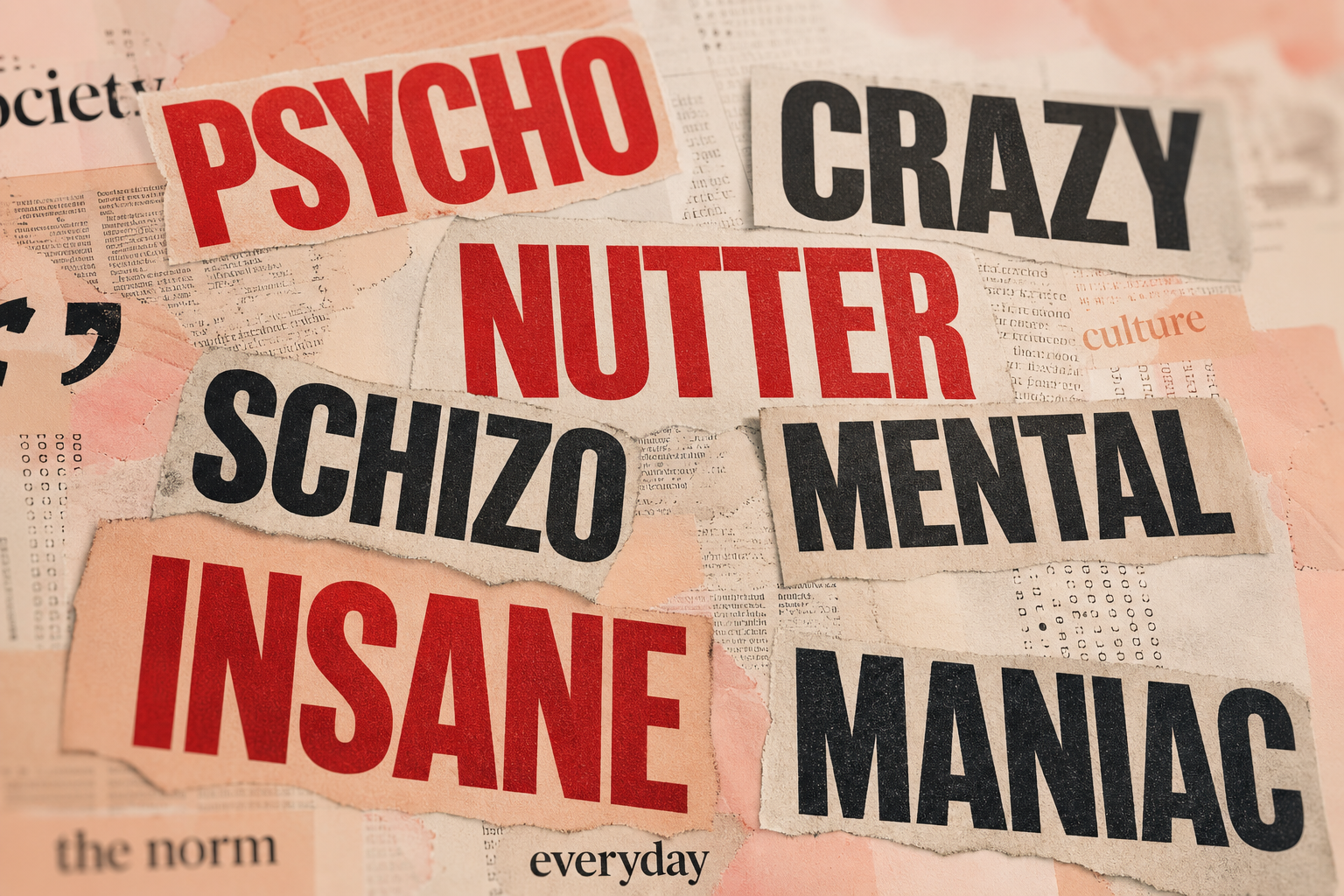
The front-page tabloid headlines shout the stigma once. Pop culture whispers it ten thousand times. Both teach the same lesson.
Say this, not that
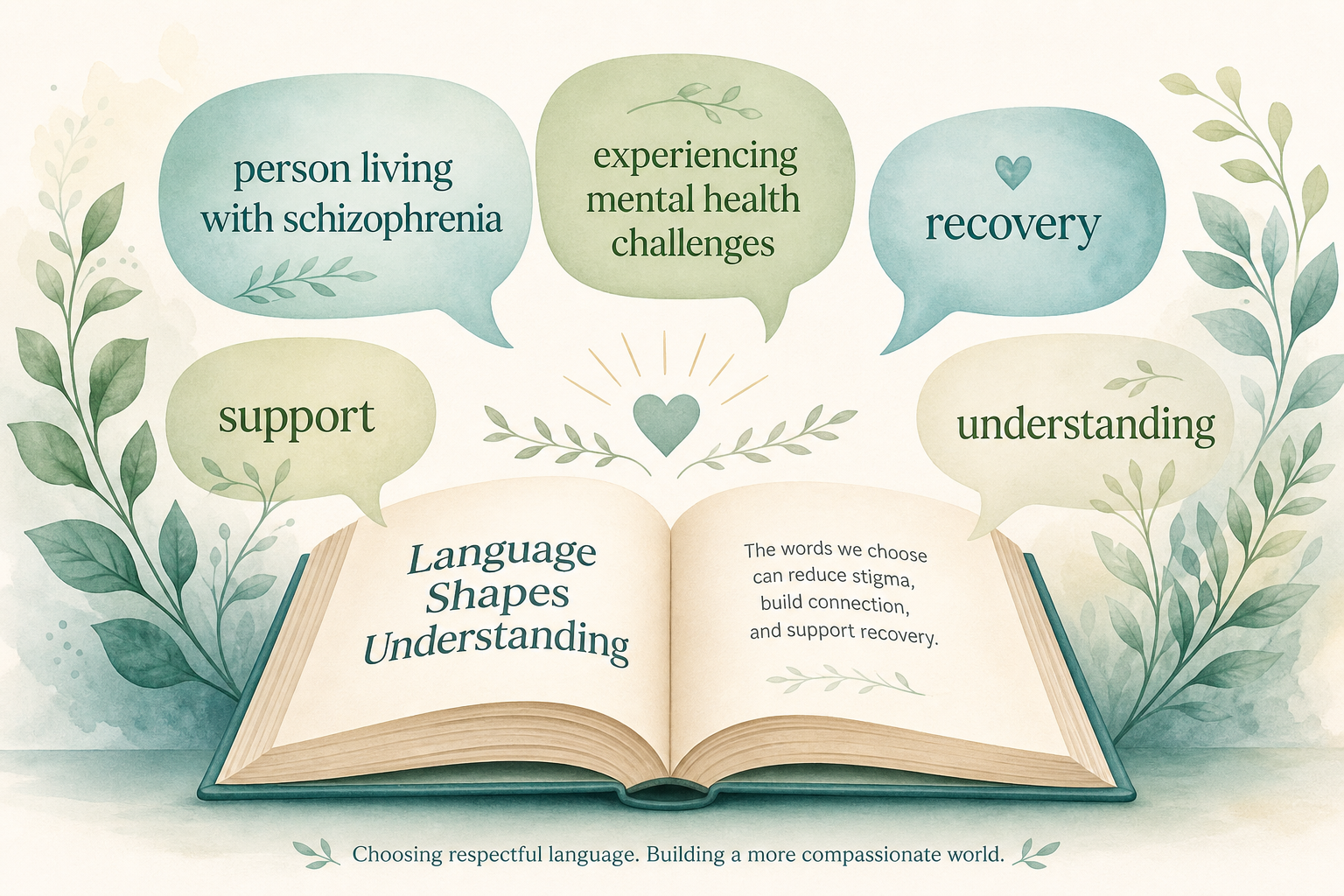
Nobody is policing your vocabulary. But if you have read this far, you already know the words carry weight. Here are some straightforward swaps.
For more detailed guidance on reporting and writing, see our journalist guidelines.
A note on nuance
Not every song or film that touches on distress is the enemy. Green Day’s “Basket Case” is genuinely about the singer’s panic disorder; Geto Boys’ “Mind Playing Tricks on Me” is a raw, empathetic portrait of paranoia. There is a clear difference between first-person art about genuine suffering and a pop hook that turns a diagnosis into a brand. The target of this page is the latter.
Some movements — like Mad Pride — deliberately reclaim words like “mad” and “nutter” to celebrate survivor culture. That is their right. Reclamation by the community is different from careless use by outsiders — the same principle that applies to every other reclaimed slur.
“The front-page headlines shout the stigma once. Pop culture whispers it ten thousand times. Both teach the same lesson — that the people behind the diagnosis are less than human. Neither is true.”
If you or someone you know is struggling, you are not alone. Call Samaritans free on 116 123, any time. In the UK: NHS 111 (option 2 for mental health crisis). If you are in immediate danger, call 999. Outside the UK, find local crisis lines at findahelpline.com.
Sources & methodology
Sources. "Sweet but Psycho" chart data: Official Charts Company and Billboard; BPI quintuple-platinum certification (3 million+ UK units as of April 2026). Zero Suicide Alliance open letter on the song and video: widely reported January 2019 (Daily Mail, The Mighty, HeadStuff). Change.org petition to Ofcom: public record. Children's television study: Wilson, Nairn, Coverdale & Panapa, "How mental illness is portrayed in children's television," British Journal of Psychiatry (2000), 176: 440–443 — 128 episodes (57 hrs 50 min), 46% containing mental-illness references, 80% of those in cartoons, "crazy" appearing 28 times. Glasgow Media Group: Philo et al., Media and Mental Distress (1996) — the majority of mental-health references in TV drama/soaps were pejorative, flippant or unsympathetic. "Split personality" public misconception: NAMI (National Alliance on Mental Illness) surveys report ~64% of the public believe schizophrenia involves a split personality; Bleuler coined "schizophrenia" (1908/1911) to describe a split between thought and emotion, not multiple identities. Asda "mental patient" costume and Tesco "Psycho Ward" outfit: withdrawn September 2013 after public backlash led by Time to Change and Mind; Asda donated £25,000 to Mind (BBC News, Guardian, Metro). Theme-park closures: Knott's Berry Farm "FearVR: 5150" (2016), Six Flags "Psycho-Path Haunted Asylum" — reported by NAMI and Psychology Today. Ofcom Broadcasting Code: broadcasters must provide "adequate protection" from harm and offence, judged case by case on context, timing and editorial intent — but mental-health slurs are not currently classified as offensive language requiring restriction (Ofcom offensive-language guidance and audience-research reports). Language guidance: Rethink Mental Illness ("Is 'schizo' a slur?"), Mental Health Foundation (UK), Time to Change, and the American Psychiatric Association reporting guide all recommend person-first language and avoidance of casual psychiatric slurs. Terminology history: Bénédict Morel coined démence précoce (1853); Emil Kraepelin systematised dementia praecox (1890s); Eugen Bleuler coined schizophrenia in a Berlin lecture on 24 April 1908 and formalised it in his 1911 monograph Dementia Praecox oder Gruppe der Schizophrenien. Bleuler's eugenics: Burghölzli clinic records, documented in Shorter, A History of Psychiatry (1997) and Mottier & Von Büren, "Controlling Deviance: Eugenic Sterilisation in Switzerland," Social History of Medicine (2018). Swiss coerced sterilisation continuing into the 1970s: Federal Commission reports. Aktion T4 estimates: US Holocaust Memorial Museum and Friedlander, The Origins of Nazi Genocide (1995). Japan renaming (2002): Sato, "Renaming schizophrenia: a Japanese perspective," World Psychiatry (2006) — 82% of psychiatrists preferred the new term for informed consent. South Korea (2012), Hong Kong (2001), Taiwan (2014): Sartorius et al., "Renaming schizophrenia — 5 × 5," Epidemiology and Psychiatric Sciences (2014). DSM-5 spectrum language: American Psychiatric Association, DSM-5 (2013). This page is educational; it is not medical or legal advice.