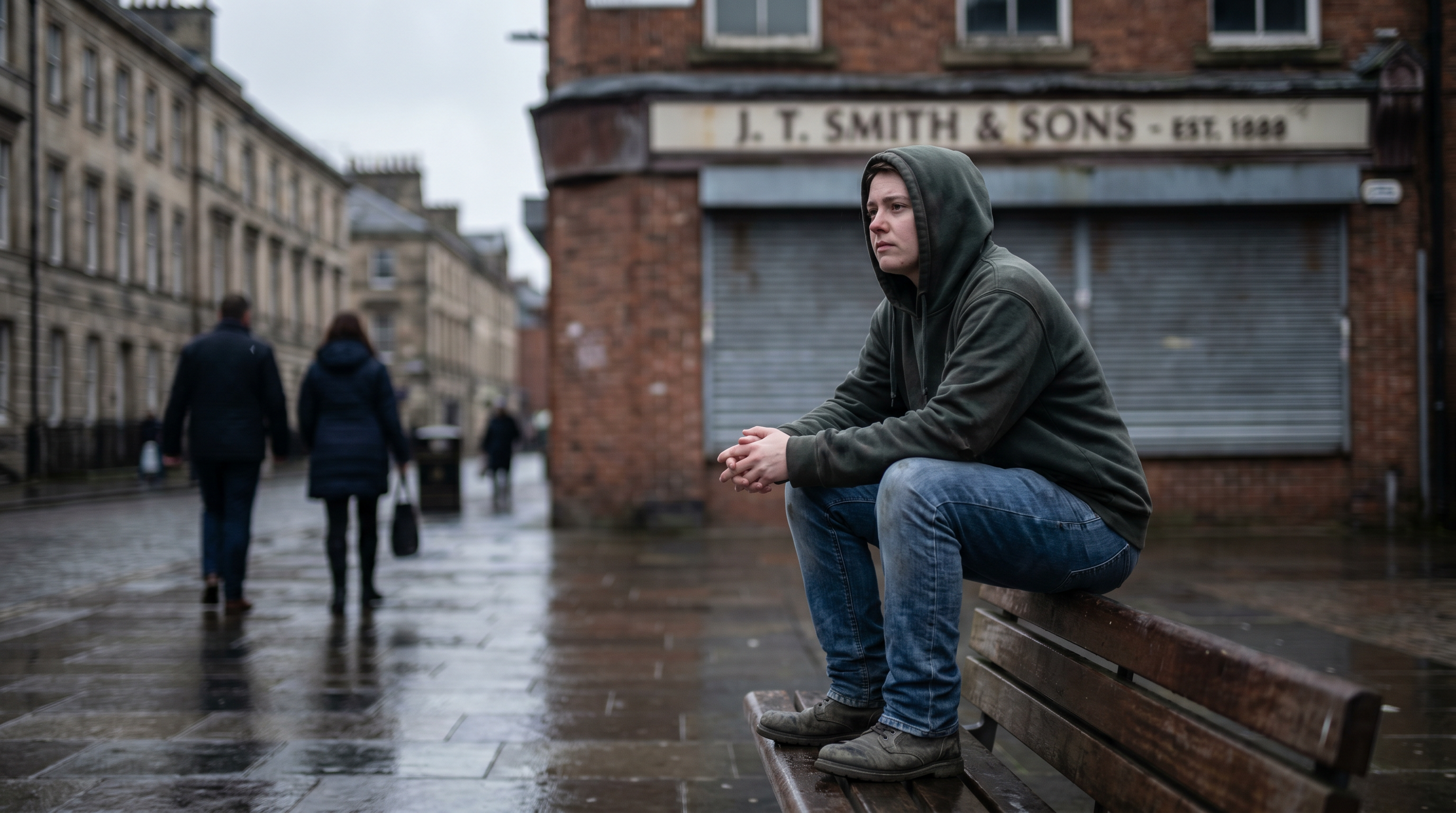
A generation betrayed
They were locked down at the most formative moments of their lives. Schools closed. Universities became isolation wards. Mental health services — already gutted by a decade of austerity — collapsed under the weight. Then, when these young people struggled to re-enter a world that had moved on without them, they were called snowflakes, shirkers and work shy.
This page is about what actually happened, who is actually responsible, and why the scapegoating of young people is not just cruel — it is dangerous.
What the data actually says
These are not opinion. They are drawn from ONS surveys, NHS Digital, the Children's Commissioner, and the government's own commissioned reports.
1 million+
Young people (16–24) currently NEET in the UK — highest in over 12 years
Milburn Interim Report, May 2026
39.6%
of 16–24 year olds economically inactive (Q2 2025)
ONS Labour Force Survey
70%
increase over the last decade in young people reporting work-limiting health conditions
gov.uk, Young People and Work, June 2026
17.4%
of 6–16 year olds had a probable mental disorder by 2021 — up from 11.6% in 2017
NHS Digital, Mental Health of CYP in England
84%
of NEET young people actively want to work or train
Milburn Interim Report, May 2026
£125 billion
estimated annual economic cost of the NEET crisis
Milburn Interim Report, May 2026
575 million
school days lost during the pandemic
Children’s Commissioner for England
270,300
children waiting for CAMHS support, with 40,000 waiting over two years (2022–23)
Children’s Commissioner for England
A pandemic hit — and the young paid the highest price
COVID did not hit everyone equally. For young people at pivotal life stages — sitting GCSEs, starting university, entering the job market for the first time — the lockdowns did not just pause life. They broke the bridge between childhood and adulthood.
Education shattered
575 million school days lost. Students averaged 2.5–4.5 hours of learning per day instead of a full school day. Government devices only reached an estimated 40% of the 1.78 million students who needed them. By autumn 2020, Ofsted reported children behind in maths and literacy, with disadvantaged pupils hit hardest.
University students locked in, locked out
Over half of university students were dissatisfied with their social experience by autumn 2020. Many were confined to halls with strangers while paying full fees for online lectures. The social milestones of young adulthood — freshers’ week, first independence, new friendships — simply did not happen.
Mental health crisis accelerated
Probable mental disorders in 6–16 year olds rose from one in eight (2017) to one in five (2023). Young women were hit hardest: by the end of the pandemic, their rate of probable mental disorders was more than double that of young men. Potential eating problems among 17–19 year olds surged from 44.6% to 58.2%.
The most vulnerable fell furthest
Young people in the most deprived areas experienced significantly higher psychological distress. Children with special educational needs reported greater anxiety and isolation. LGBT+ young people were more likely to say their mental health had worsened. These were not equal-opportunity lockdowns.
Instead of help, they got blame
The mechanism is ancient. When a society fails, it finds someone to blame. In the 1930s it was immigrants and “degenerates.” In tabloid Britain, it was “benefit scroungers.” Now it is a generation of young people whose crime is being ill in a system that made them that way.
If you have read our History page, you will recognise this pattern. The target changes. The mechanism does not.
“We are becoming a sick note culture.”
Mel Stride, Conservative Work and Pensions Secretary, 2024
Stride argued that people with mental health conditions were being signed off for what he called the "ups and downs of life." Disability rights groups condemned it as demonising the sick and disabled.
“There is a generation of snowflakes who can’t cope with the real world.”
Widespread media framing, 2023–2026
Nacro found that UK media outlets are twice as likely to portray young people negatively as positively, framing them as lazy, weak or unpatriotic.
“These are not shirkers and snowflakes.”
Pat McFadden, Labour Work and Pensions Secretary, 2026
McFadden rejected the characterisation — yet his own government’s March 2025 Pathways to Work paper proposed £4.8 billion in benefit cuts, with the government’s own impact assessment acknowledging 250,000 additional people could fall into relative poverty.
“The myth of the lazy youth is a cruel characterisation.”
Alan Milburn, former Labour cabinet minister, 2026
Milburn’s interim NEET report found 84% of NEET young people actively want to work. He described the “snowflake” label as a “cruel myth” that ignores systemic failure.
Every government failed them
This is not a party-political page. Conservative austerity gutted the services. Labour promised change and then proposed their own round of cuts. No major party has delivered what young people actually need: properly funded mental health care, a genuine path into work, and an end to the punitive rhetoric.
Local authority spending on youth services cut by 73% in real terms. Widespread closure of youth centres and early intervention programmes. CAMHS left so under-resourced that nearly 40,000 children waited over two years for support by 2022–23.
The Work Capability Assessment became synonymous with punitive welfare — stripping benefits from claimants who could not attend appointments, while Mel Stride publicly dismissed mental health conditions as the "ups and downs of life."
Despite pledging to end "blame culture," the March 2025 Pathways to Work Green Paper proposed £4.8 billion in welfare cuts. New PIP claimants face tighter eligibility from November 2026. The government’s own impact assessment: 250,000 more people in relative poverty by 2029/30.
The Universal Credit health element for new claimants cut from £97/week to £50/week starting 2026/27. Mind and Scope warned the measures would push disabled people deeper into poverty and worsen the mental health crisis the government claims to be solving.
For every £25 spent on benefits for young people, only £1 goes to employment support. The system pays people to be ill rather than investing in making them well. Successive administrations have known this and none have fixed it.
CAMHS has never received funding proportionate to the scale of child mental health need. Children are roughly 21% of the population but receive a fraction of NHS mental health spending. The workforce vacancy rate is 9.9%, with over 10,000 nursing posts empty.
Untreated today. Severe tomorrow.
Untreated anxiety and depression are not just distressing in themselves. Research shows they share underlying vulnerabilities with more severe conditions — including psychosis. When mild mental health problems are left to fester, they can worsen through a process researchers call “behavioural sensitisation”: cumulative stress exposure creates elevated emotional responses that make the brain more vulnerable to crisis.
73% of people at clinical high risk of psychosis have at least one other mental health condition, most commonly depression (41%) or anxiety (15%).
Prolonged untreated psychosis (median 74 weeks to first treatment) is associated with structural brain changes, increased symptom severity and reduced treatment effectiveness.
Childhood mental health problems are projected to result in over £1 trillion in lost earnings for the current generation.
Nearly half of those waiting for mental health care report that their condition worsens during the wait.
The schizophrenia connection
This is the schizophrenia time bomb. A generation whose mild anxiety and depression went untreated during lockdowns, whose CAMHS referrals were closed before they were seen, whose GPs were told to prescribe apps instead of therapy. Some of those young people are now progressing toward conditions that could have been prevented — or at least caught early. Every month of delay makes recovery harder.
It is not your fault
If you are struggling — with anxiety, depression, the feeling that the world moved on and left you behind — you are not lazy. You are not a snowflake. You are not “work shy.”
You are the product of a system that locked you down, stripped your support, and then blamed you for falling. That is not weakness. Surviving it is strength.
84% of NEET young people want to work or train. That number tells the true story. Not the headlines.
Need support right now?
If you or someone you know is struggling, you are not alone.
Samaritans: 116 123 (free, 24/7)
Crisis Text Line: text SHOUT to 85258
Childline: 0800 1111 (under 19)
Outside the UK: findahelpline.com